Where the Yews Came First


Armed with my stylish Swedish photography assistant, a Hasselblad X2D camera, a selection of equally beautiful lenses, tripod and lights, I set off for the Radnorshire village of Llanfihangel Nant Melan, the church of St Michael by the Summergill brook. The reason was simple: an earlier discovery of a dragon myth, and the knowledge of a ring of ancient yew trees tied to it. I had already photographed the yews at two of the other sites in the story, and this visit would bring me closer to completing the circle. The thought of these trees, older than the church and older perhaps than the tale itself, fuelled me with an eagerness to see them for myself.
The A44 wound through the hills ahead of me, the long road that carries travellers from Oxford to Aberystwyth over the spine of mid-Wales. Long before the tarmac the road was raised in local stone as a turnpike, and earlier still it was a drovers’ way, its soil and rock beaten hard by hooves as cattle were moved east to the English markets. I passed the Fforest Inn, a sixteenth-century inn where herds were once driven east through the uplands. Cattle came first, but flocks of sheep and hardy Welsh ponies were also moved along the same road. Then its benches were filled with farmers, farm labourers, foresters, hunting parties, and the drovers themselves. Now the clientele has changed. Local inhabitants still call in, joined by holiday makers and travellers, and in summer the motorcyclists who lean into the bends of the A44 before stopping here on their way through the hills. The building remains a pause in the road, a place of shelter before the descent into the valley.
To my left rose Mynd Hill, its slopes bare and sweeping, cut and drawn out by the slow labour of ice. The valley opened. The wind suddenly picked up, rushing through the ice-hewn gap and whistling through the windows of my wife’s Jeep. The old workhorse of a vehicle, usually kept for towing a horsebox, seemed to strain into the gusts. The wind grew stronger with every furlong closer, as if the place itself had summoned it. I felt a flicker of unease, like a scene from The Omen when weather bends to something unseen. I was staying until dusk, and the thought of night closing in gave the air a sharper edge. In truth the sudden shift was most likely the work of one of the large dark clouds that hung over one of the distant hills, dropping its load of welcome rain onto the droughted hillsides. Even so, the gusts carried with them a strange energy, as if the land itself exhaled in relief.
I arrived at the church and parked in the car park of another old drovers’ inn, The Red Lion. By coincidence it had been a favoured overnight stop for my wife Charlotte’s grandfather on his way to a remote holiday cottage near Machynlleth, a place he returned to for four decades. The sense of passage along this road seemed to deepen: drovers with their herds, travellers on their way west, and now my own small pause before stepping into the yard of St Michael’s.
Yet when I stepped through the gate into the churchyard the air changed. It became calm, barely a breeze, as though the yews themselves held the wind at bay. The trees stood dense and heavy, their branches knitted tight above me, and in their shadow the restless valley seemed far away. Even the sound of the road fell back. Time slowed, and the stillness pressed close, not empty but waiting.
St Michael’s stood on its raised platform, a modest nineteenth-century Norman revival building set against the slope. Long before the surviving bell of 1633 was hung in the west gable, there may have been others, medieval bells now lost to time, and before them only the yews themselves to sound the sanctity of the place.
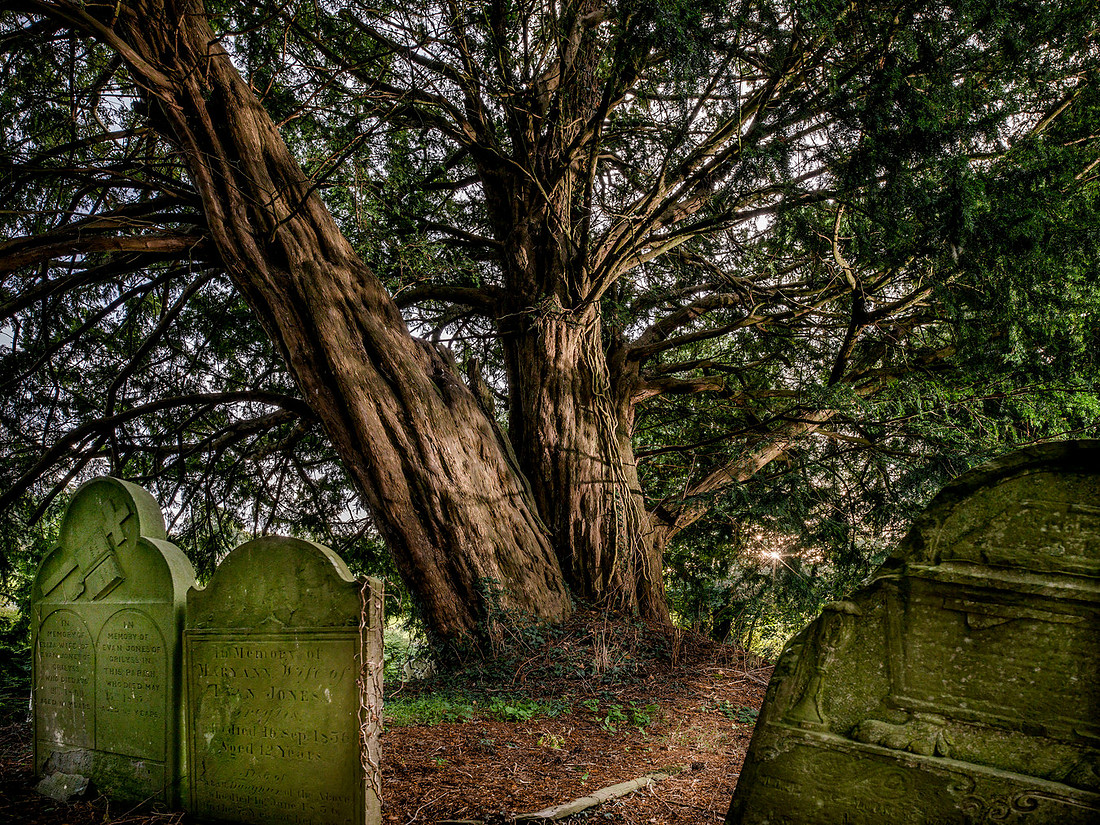
There the yews rose, each one different. Some were split open, their hollowed trunks gaping like caverns, dark enough to step inside. Others stood solid and whole, their bark ridged and furrowed, their crowns thick with evergreen shade. Roots pressed into the stones. Gravestones cut from the same local stone leaned against them. Orange light from the falling sun fell thin through the branches, green and heavy. At the base of one of the yews a long stone lay half-buried, a quiet fragment that may be the last trace of a prehistoric ring, echoed in the Bronze Age circles and menhirs of the surrounding hills, although its age is still unknown.
The tale says a dragon came out of Radnor Forest and laid waste to the land. Michael the archangel fought it here, and when it fell, four churches were built in a circle to hold it down. St Michael’s is one of them, a mark on the body of the beast.
But the yews were here first. Long before the nave. Long before the bells. Across Britain such trees marked the sacred ground of the old world. Evergreen, poisonous, long lived, they carried both death and renewal. It may be that these were planted by people who came before, to make the valley holy. The church and its trees sit beside the A44, the same line that was once a turnpike and earlier still a drovers’ way. Beyond the yard a linear bank and mill earthworks lie on the valley floor, raised and edged with the same stone taken from the hill. Every layer speaks of movement and marking, track, stone, tree, church, each one built upon another.
Coiled trunks like the dragon’s body. Hollows torn open like wounds. Branches spread like wings pressed to earth. The story is written there, not in stone, but in wood.
So the churchyard holds more than one layer. Pagan grove beneath Christian yard. Beast into saint’s triumph. Fire into shade. At the centre the yews remain, older than the story, rooted still in the valley. They are the same circle of trees that drew me on from one site to another, each visit another step into the myth.
The dragon of Radnor is not gone. It breathes in the trees, its fire living now as green flame, the same flame that caught the last orange light of the sun, although its true age, like the stone beneath the yew, is still unknown.